
Türkiye
participants
The main goal of this project was to give children with Down syndrome and autism a fun and special experience with science and technology. We wanted to make sure each child felt happy and included on World Children’s Rights Day. We aimed to ensure that children with Down syndrome and autism felt truly valued through this project. This is what we were trying to do with this project for the children with Down syndrome and autism. Our objectives were to introduce foundational STEM concepts through specially designed hands-on activities that address to diverse sensory and learning needs; to support developmental skills such as fine motor coordination and cognitive growth through interactive tasks like building and sorting; to cultivate a positive and encouraging social atmosphere that emphasizes participation and inclusion; to enhance engagement by blending multisensory elements such as storytelling and creative snack preparation into the learning process; and to highlight and honour the fundamental rights of every child—especially the rights to education, play, and meaningful inclusion.
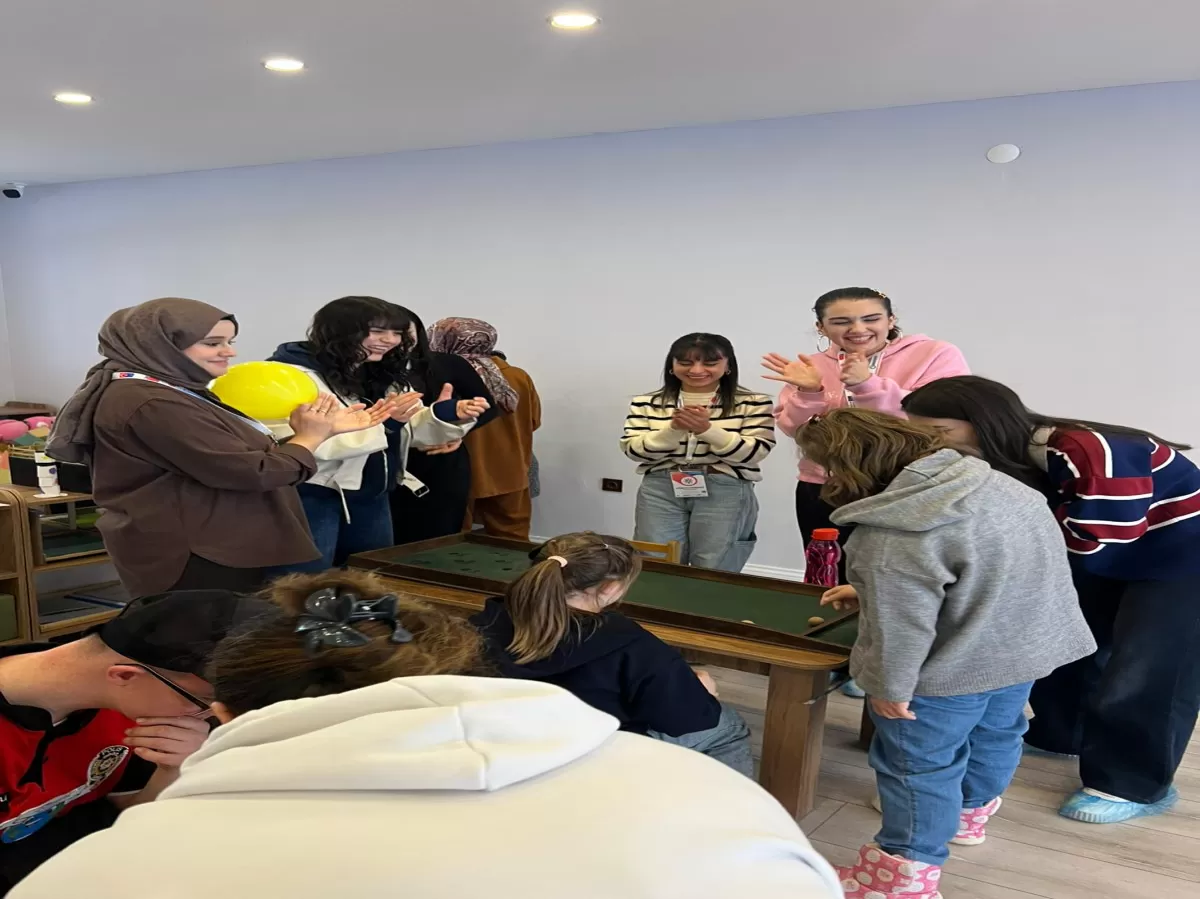
In commemoration of World Children’s Rights Day, the University’s Child Studies Centre implemented a specialized STEM Kindergarten Workshop designed to uphold the principle of educational equity, specifically focusing on providing high-quality, inclusive learning opportunities for a cohort of eight children with special needs, including those diagnosed with Down syndrome and autism. The primary objective of the program was to demystify the fields of Science, Technology, Engineering, and Mathematics (STEM) by utilizing adaptive, sensory-friendly methodologies that align with the specific developmental trajectories of the participants, ensuring the environment was physically and cognitively accessible based on Universal Design for Learning (UDL) principles. To address varying sensory profiles, the activities utilized tactile and visual stimuli; for instance, a dedicated woodwork station was established where children engaged in sanding wooden pieces to explore textures, subsequently building their own wooden ships and robots. These creations were then tested in water tanks, allowing participants to observe buoyancy and structural balance firsthand. While the engineering station replaced traditional materials with soft, ergonomic building blocks to minimize the frustration of complex fine motor requirements, nature-based science explorations and color-coded numeracy games transformed abstract mathematical concepts into tangible, interactive experiences. A centrepiece of this pedagogical intervention was the “Sensory Storytelling” station, which integrated literacy with life-skills training by requiring the eight participants to follow pictogram-based instructional sequences while listening to a narrative centered on themes of friendship and discovery. This dual-layered approach proved particularly effective in fostering both fine motor precision and social-emotional regulation, allowing children to practice executive functioning skills—such as sequencing and task completion—within a supportive social context. Based on pedagogical observations, this initiative demonstrated that when STEM concepts are introduced through adaptive and play-based frameworks, they serve as powerful tools for empowerment, ultimately transcending basic skill acquisition to cultivate a profound sense of joy, agency, and belonging for every child involved. The workshop concluded with an inclusive celebratory gathering that emphasized the university's commitment to the dignity and social integration of the participants, providing a replicable model for inclusive early childhood STEM education that honors the fundamental rights of the child in a practical, impactful setting with life-skills training by requiring the eight participants to follow pictogram-based instructional sequences to assemble healthy snack packs while listening to a narrative centered on themes of friendship and discovery. This dual-layered approach proved particularly effective in fostering both fine motor precision and social-emotional regulation, allowing children to practice executive functioning skills—such as sequencing and task completion—within a supportive social context. Based on pedagogical observations, this initiative demonstrated that when STEM concepts are introduced through adaptive and play-based frameworks, they serve as powerful tools for empowerment, ultimately transcending basic skill acquisition to cultivate a profound sense of joy, agency, and belonging for every child involved. The workshop concluded with an inclusive celebratory gathering that emphasized the university's commitment to the dignity and social integration of the participants, providing a replicable model for inclusive early childhood STEM education that honors the fundamental rights of the child in a practical, impactful setting.
Outcomes
For the children with Down syndrome and autism, the event was a joyful and engaging experience. They were able to take part in fun, hands-on STEM activities adapted to their needs. We saw them smiling, exploring, and participating in a supportive environment. This helped them feel included and valued on their special day. For the university students who volunteered, it was a practical learning opportunity. They gained real experience in inclusive education, adapted teaching methods, and working directly with children with different needs. Many said it was meaningful to see how their studies could be applied in a real-world setting. For the Child Studies Center, the event strengthened their role as a space for inclusive education and community outreach. It demonstrated how the university can actively support children with special needs and their families. Overall, the main outcome was a successful and meaningful day that combined learning, inclusion, and celebration. The event also created a practical model that can be used again in the future for similar workshops.
This activity is part of the project:
Inclusivity for All, Now!